
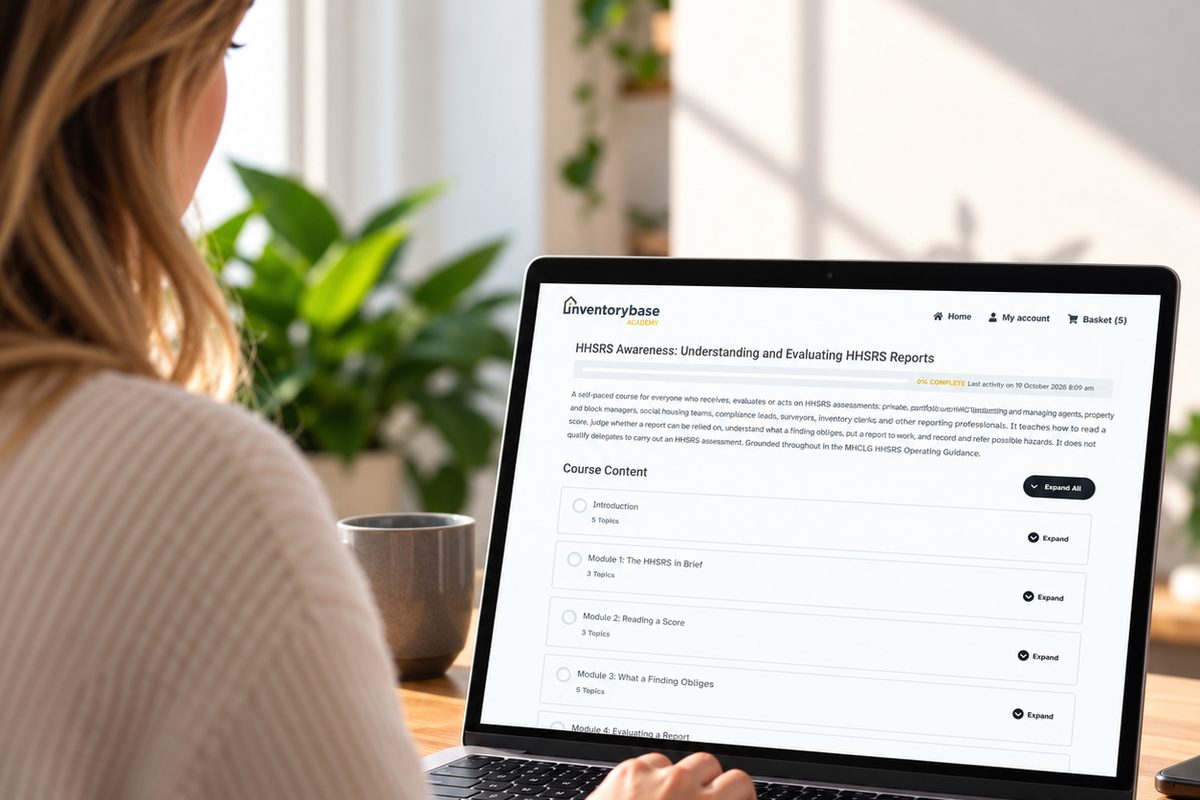
Understand and evaluate HHSRS reports with confidence on our self-paced Awareness course, designed to give you practical skills, including:
- the HHSRS in brief: risk, not condition, the vulnerable group and the twenty-one hazards, and what changed in June 2026
- reading a score: the two judgements, the formula, bands and categories, worked through on a real example
- what a finding obliges: the local authority’s duties and options, appeals, Awaab’s Law across the four nations, and where social housing fits
- evaluating a report: what a sound assessment contains, ten warning signs, and reports on HMOs and flats
- who is competent to assess or investigate, and how to show why you chose them
- observing, recording and referring a hazard, and where your role ends
- putting a report to work: planning works, safety records and accountability
- working with landlords and tenants, and communicating findings clearly and without blame
At the end of the course you will be able to read any HHSRS report, judge whether it can be trusted, and know what has to happen next.
The course is written for landlords, letting agents, property and block managers, social housing teams, compliance leads, solicitors, surveyors and inventory clerks: anyone who receives, evaluates or acts on HHSRS assessments. It does not teach you to score a hazard yourself; our HHSRS Risk Assessment: Core Practitioner Programme does that.
You can revisit any module at any point during your learning, or use the material as a refresher.
If you would like to discuss your training needs, or book for a team, please email academy@inventorybase.com or call 03333 444 506.
Information to note: Awaab’s Law and the HHSRS are changing over the coming months, and the course is updated as they do. It is worth returning to it after you finish to stay up to date.
Course details, and what they mean for you
| Course details | What that means for you |
|---|---|
| Self-paced online learning, on any device | Take it in a day, or a module at a time over a week or two. Nothing is locked. |
| About six and a quarter hours of structured learning | Short enough to fit around work, with each module taking under an hour. |
| One house, two reports: 12 Linden Close runs through the course | You learn by checking real-looking reports, not by memorising rules, so the skills carry straight into your inbox. |
| Reading and checking a score, and ten warning signs of a weak report | You can tell a report you can rely on from one you need to challenge, before you commit money or make a decision. |
| What a finding obliges under the Housing Act 2004, Awaab’s Law and the Decent Homes Standard | You know what a Category 1 or Category 2 finding means for a landlord, and what deadlines may follow. |
| Who is competent to carry out an assessment or an Awaab’s Law investigation | You can choose the right person for the job, and show why, if that choice is ever challenged. |
| Three tools to use at work: a Report Review Checklist, a Hazard Referral Note and an Awaab’s Law Clock Card | Practical templates you can use the day you finish. |
| Final assessment: 27 scenario questions, pass mark 80 per cent, and you can retake it | A fair check of what you can do with a report, with feedback on every answer. |
| Certificate of completion, recording about six and a quarter hours of structured learning | Evidence for your CPD record and for your employer. |